

Transcription
How the Mauthausen Memorial makes complex interviews searchable with Amberscript for research
Case studies
24 Apr 2026
3 minute read
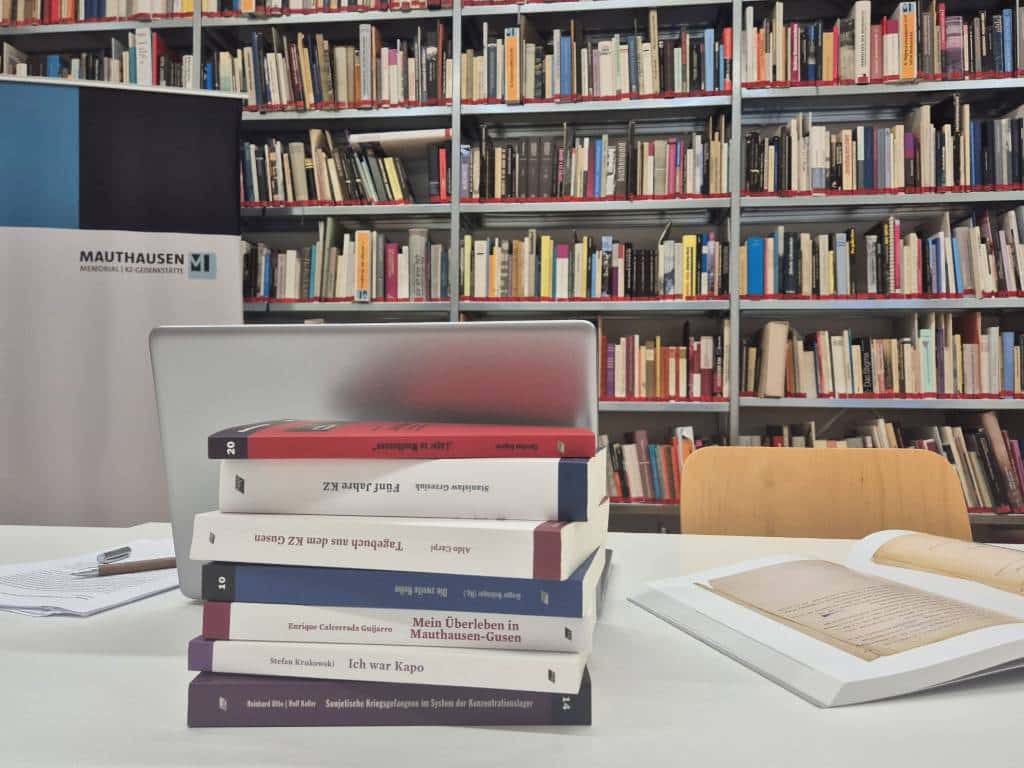
About the Mauthausen Memorial
The Mauthausen Concentration Camp Memorial is one of the central institutions for Holocaust remembrance and historical-political education in Austria. Its Research and Collections Departments manage an extensive archive, including the oral history collections with hundreds of interviews. These document the individual experiences of survivors from all over the world, eyewitnesses from the regional environment of the camp, and occasionally US liberators. A core part of their mission is to preserve and make the history of the Mauthausen-Gusen concentration camp complex accessible to the public, as well as to support ongoing research. To fully unlock the value of this archive for research and education, each interview needs to be accurately transcribed and made searchable.
The challenge: balancing audio complexity, manual work, and cost
The Memorial’s team regularly processes interviews in various languages, many of which include poor audio quality, background noise, unclear speech, and strong dialects. Before working with Amberscript, transcription was handled partly in-house and partly through external providers. This led to inconsistent accuracy and relatively high costs, while still requiring significant manual effort from the team. To meet academic standards, team members have to review recordings themselves. With automatic transcriptions, but also in some cases of other external providers, transcripts had to be extensively corrected, which significantly slowed down the research process. Given the scale of the archive and the importance of accuracy when working with sensitive historical content, the team was looking for a more reliable and cost-effective way to produce high-quality transcripts.
The solution: a transcription partner that meets research standards
Because of the academic nature of the content and the complexity of the audio, accuracy and strict adherence to transcription guidelines were essential.
The Mauthausen Memorial partnered with Amberscript’s human-made transcription service to produce transcripts in line with strict academic standards, ensuring they met the requirements for research. A key part of this was consistently following detailed transcription rules, which was essential for the project. By working with experienced language experts familiar with complex audio and sensitive material, Amberscript provided a solution that matched both the quality requirements and the scale of the cataloguing projects.
The results: turning audio into accessible and searchable data
With high-quality transcripts in place, the Memorial was able to transform its oral history collection into a searchable and accessible resource. Each interview can now be tagged with relevant keywords, enabling both internal researchers and external scholars to quickly find specific information, a process that was previously extremely time-consuming. Even the most challenging recordings, such as interviews with elderly speakers or severely degraded audio, were transcribed to a usable standard and delivered on time. The inconsistencies experienced with previous providers were no longer an issue. What once required hours of manual listening can now be accessed in seconds, opening up hundreds of survivor testimonies for deeper research and analysis.

To sum it up
With Amberscript’s human-made transcription, the Mauthausen Memorial turned a large and complex collection of interviews into accurate, searchable transcripts. This improved research efficiency, increased accessibility of the archive, and eliminated previous quality and consistency issues.

Need to turn complex audio into accurate, searchable transcripts at scale? Get in touch with Amberscript to see how we can help.