Automatically generate subtitles
Autogenerate subtitles in German
Easily get German subtitles using our Automatic Speech Recognition (ASR) software. German is the 10th most spoken language in the world, with 100 million native speakers around the world. It’s estimated that there are 250 dialects that exist within the German language. The German language is the official language of Switzerland, Lichtenstein, Luxemburg, Belgium, Austria, as well as Germany itself. High German (Hochdeutsch, standard German) is known as the most commonly spoken German dialect, widely spoken in Germany’s central and southern highlands, Austria, and Switzerland.The ASR can detect many German dialects and colloquialisms.
4.3 on Trustpilot

4.5 on Google


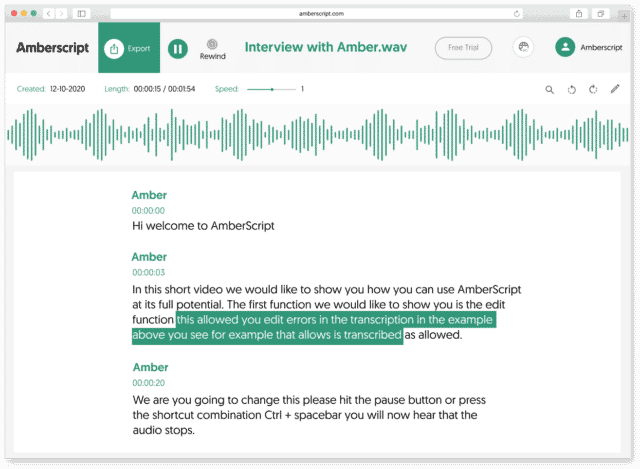
How to automatically generate German subtitles:
1. Upload your video in GermanUpload your video. Select the number of speakers and the audio language. Sit back and relax while AI generates the subtitles.
2. Edit your subtitle fileYou’ll receive your subtitle text. Easily make any changes in our cloud-based editor.
3. Export in multiple formatsWhatever formats you need, we’ve got you covered. docx., .txt, .srt, .json, .vtt, or EBU.STL
Check out our
Trustpilot reviews
Excellent
 Basé sur 376 commentaires


Très bonne expérience générale.
Super application qui m’a fait gagner…
Gain de temps et efficacité
Transcription en français
Rapide et efficace
Frequently Asked Questions
-
Comment générer des ous-titres codés ?
Vous pouvez générer automatiquement des sous-titres codés à l’aide d’Amberscript. Notre logiciel vous permet d’exporter la transcription basée sur des fichiers audio / vidéo sous forme de fichiers SRT, EBU-STL ou VTT, qui peuvent facilement être insérés dans un éditeur vidéo. Voulez-vous en savoir plus ? Voici un guide étape par étape.
-
Comment ajouter des sous-titres à une vidéo YouTube ?
Pour ajouter des sous-titres à votre vidéo YouTube, ajoutez simplement le fichier que vous avez créé avec Amberscript à votre vidéo dans Youtube Studio. Cliquez sur «sous-titres», puis sur «ajouter» et enfin sur «télécharger le fichier» et sélectionnez le fichier SRT.
-
Ajoutez-vous des horodatages ?
Oui, les horodatages sont inclus dans la transcription. Vous pouvez choisir d’exporter la transcription avec ou sans horodatage.
-
Offrez-vous vos services dans d’autres langues ?
Oui, nous le faisons. Notre logiciel prend en charge 39 langues différentes et nous pouvons fournir des sous-titres traduits via les services de sous-titrage manuel en utilisant notre réseau d’experts dans 15 langues différentes. Des sous-titres traduits peuvent être demandés lors du processus de téléchargement. Si vous voulez demander une langue qui ne figure pas sur notre liste, merci de nous contacter.
-
Puis-je graver les sous-titres directement sur ma vidéo ?
Si vous avez exporté la transcription sous forme de fichier SRT, EBU-STL ou VTT, vous pouvez facilement les graver sur votre vidéo à l’aide d’un logiciel de montage vidéo.
-
Comment commander des sous-titres traduits ?
Pour commander des sous-titres traduits, vous pouvez télécharger votre fichier comme vous le feriez habituellement. Sélectionnez ensuite les sous-titres manuels. Une fois que vous avez sélectionné cela, une option apparaîtra où vous pourrez sélectionner la langue dans laquelle les sous-titres ont besoins d’être traduits. Si la langue que vous désirez ne fait pas partie des options, vous pouvez nous contacter via notre formulaire de contact.
Using Automatic Speech Recognition (ASR) for generation German subtitles
Subtitling is made easier with automatic speech recognition. Subtitling can be automated, saving hours of time and effort. It is beneficial to add subtitles to digital content in order to ensure accessibility and increase engagement of your content.
With our subtitle generator, you can convert your audio file into subtitles automatically. Through our online text editor where you can easily edit the text, highlight sections, and find specific text. Subtitles can make it easier to understand fast-paced language or dialogue that has a foreign accent or is difficult to understand. The advantage of subtitles is that they can also assist in improving native language writing skills, including spelling, punctuation, and grammar. Additionally, subtitles or closed captioning enables your audience to watch videos where it’s difficult to hear, such as in offices, libraries, or on public transportation.